In October 1928, Virginia Woolf delivered two lectures in Cambridge which later became “A Room of One’s Own.” In the essay, she writes about wandering into the university library and being immediately stopped by “a deprecating, silvery, kindly gentleman, who regretted in a low voice as he waved me back that ladies are only admitted to the library if accompanied by a Fellow of the College or furnished with a letter of introduction.”
The rest of the book is a well-known meditation on the place – and lack thereof – for women in literature. The essay was published in the fall of 1929. Around that time, Janina Hosiasson arrived at Cambridge to spend the year as a visiting philosopher. Would she read Woolf’s book? It is hard to tell whether she cared about reading anything that was not formal philosophy. Being so used to walking the halls of Warsaw University and attending any seminar she wanted, did she run into trouble initially, stepping on lawns reserved for the Fellows or bluntly walking into libraries without a proper introduction?
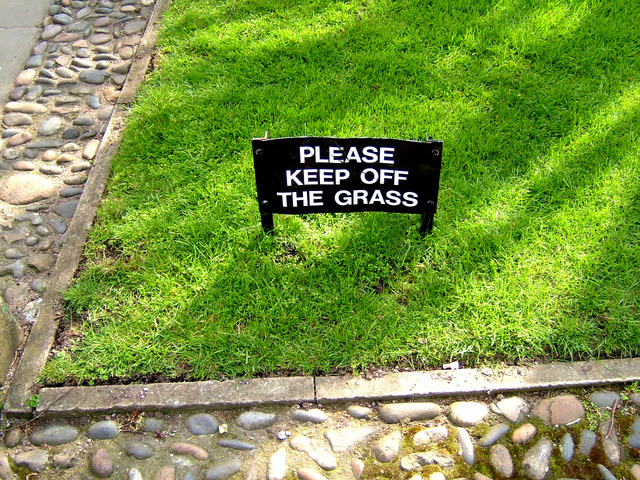
Photo by Def Defman from FreeImages
Funded by the Polish ministry of education, Janina spent the whole academic year in Cambridge. She briefly recounted her experience in a talk and a short article which came out in a popular science magazine, Wiedza i Życie. In her account Janina writes a little about the women at the University of Cambridge. She says that the number of female students could not, per university rules, exceed 500, while the total number of students at the time was over 5000. Some lecturers, like C. D. Broad, would not take up any female students for tutoring.
In spite of the obvious contrast with what she must have been used to, she clearly enjoyed herself there. She attended seminars and public talks, given, among others, by Einstein, Weyl, and Planck. She thought that Wittgenstein’s powers of persuasion came from his unshaken belief in what he was claiming, rather than from actual arguments. Her favorite lecturer was G. E. Moore, who was also, it seems, the reason why she wanted to go to Cambridge in the first place. But even he got accused by her of not being logically sophisticated enough. She noted that until she came to Cambridge, none of the philosophers there (with the possible exception of Ramsey) had any idea about all the results in logic that the Polish had been producing. The Polish logic culture was clearly something that was a source of pride. It was not going to be long until the international public caught up with the phenomenon; just as Janina was settling into her year in England, Tarski was making his first contact with the Viennese.
In the popular article she described in detail the organization of the university and the studies there: how the academic year was divided into parts, what kinds of classes and exams students took, and how much it all cost. She was particularly impressed with the level of comfort that their money bought the Cambridge students: they lived in spacious apartments inside colleges and could spend all their time focusing on their studies, as opposed to having to provide for themselves by working outside of the university.
Student associations also worked differently than in Warsaw:
The meetings are held in wonderful college apartments, usually those of the lecturer. The attendees sink into the deep armchairs, ottomans and soft carpets; nearly everyone smokes a pipe and drinks black coffee. I attended the meetings of the so-called Philosophy Club, an academic students organization, led by one of the professors. I could see for myself the high level of discussions and the succinct and relevant manner that the students spoke in. The discussions were primarily systematic and not historical. Both this fact and the high level of discussions are far ahead of other European universities, like the Sorbonne; they resemble more the university in Warsaw.
Warsaw, it seems, was the real place to be.
 Marta Sznajder
Pingback: Janka, Antek | Marta Sznajder