We are sleeping for the first time in a prison cell, where throughout the night our legs are hurting. Call this fact f1. Can we raise the degree of belief in the fact that the next night our legs will also hurt? Let us call this future fact f2. (…) Now our question comes down to whether there are any possible causes of f1 such that, if we assume them, f1 does not lower the level of confidence in f2. Suppose for instance that besides w the only possible cause of f1 is (next to some humidity in the cell) rainy weather on the day preceding the night when we were in pain, and the fact that on that day we stood outside for a long time, waiting for bread.
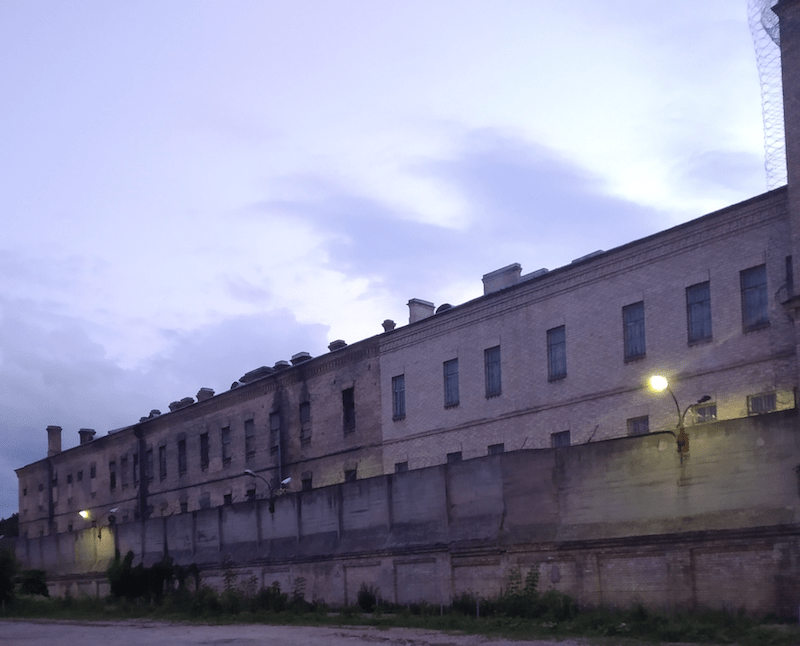
There are multiple, often conflicting, accounts of what happened to Janina in Vilnius after the arrvial of the Germans in the summer of 1941. What is certain is the sequence: arrest (when? why?) – imprisonment (where? how long?) – death (when? how?). The details are scattered, and often given second-hand by people who were told decades before by other people, who heard it from someone who saw it, etc., etc.
There was also a curious recollection written by one of her philosophy colleagues in Vilnius, Henryk Elzenberg, who said that while in jail, she continued to work on the topic of analogy and even wrote a sketch of an article there: “I remember that at least one example was provided to her by her prison life.”
By sheer chance and luck, one of the first traces of Janina that I found in the archives was a manuscript which, in all probability, was that very sketch. A handful of small pages covered in handwriting, entitled “On Reasoning. A Draft” (“O wioskowaniu. Szkic”). In there, starting from her probability axioms, Hosiasson explores various conditions for rationality of inductive reasoning by induction. The note is stored among the papers of Tadeusz Czeżowski, who was a philosophy professor in Vilnius until December 1939, and a leader of the philosophical activity after the Polish university was closed (as well as a savior of a number of Jewish lives later on). This also fits the story, as Elzenberg mentioned in his recollection that it was Czeżowski who referred Janina’s prison work at a seminar.
At the time, I saw it as a heart-breaking memento of its author’s fate, but not really as a piece of research. I could not let go of the image of her in that prison – likely the Lukiškės Prison, just across the square from where she had lived previously – always thinking about probability, trying to make the best use of the precious scraps of time and paper.
It was only months later, after I had started working my way through another of Hosiasson’s papers on analogical reasoning, that the full meaning of this quote, and the manuscript it came from, became apparent. I rushed back to Poland to copy the whole thing (don’t even get me started on all those Polish archives that do not allow you to take photos even for private use).
From the tracking slips in the folder, I could tell that in the last couple of decades only a handful of people had looked at this material. But I was the only one of them who also happened to be intimately familiar with the work that Carnap did on analogy in inductive logic in the 1960s. I might have been the only person in the world who could see what needed to be seen, and who was able to read it in Polish: that in that God-forgotten time and place, while trying to save her sanity by doing the thing she loved most, Janina happened to be figuring out things that, as usual for her, were well ahead of her time. When Carnap tackled the same problem twenty-five years later, he arrived at basically the same conclusions.
After nearly three years – very much in Janina’s spirit, too, as she took forever to complete anything, and often missed deadlines and broke promises of a speedy shipment of abstracts and articles – her manuscript is now typed, translated, and its contents and importance explained as well as I was able to. It is back in the world, and soon enough, I hope, it will be published in a place that she would approve of.
Here you can find the paper together with the commentary and all the references, including the one to Elzenberg’s letter. And here is Hosiasson’s first paper on analogical reasoning, the 1941 “Induction et analogie: Comparaison de leur fondement.”
 Marta Sznajder